I AM STILL INSIDE THE SKIN OF MY CHARACTER
67

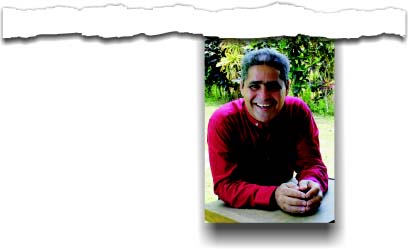
MANUEL DAVID ORRIO DEL ROSARIO


He had polio as a child and walks with a limp as result. But this didn't stop him from riding all over Havana on his bicycle, his cane strapped on the side, visiting people and thinking over the article he would write that week for Cubanet, the Miami-based agency established to promote "independent journalism". "I was their star journalist," he mischievously declares, making it clear that he was fully aware of all the tricks behind this business.

He is driven and rigorous, painstakingly verifying information and dates. And all his careful research leads to the same conclusion: the dependence of these "independent" journalists on the money and the whispered instructions from the U.S. Interests Section. It doesn't take much to figure this out; and he is able to attest to the inner workings of the business of news, the profitability of relentless criticism of the Revolution, the dirty tricks aimed at denying the Cuban people of their daily needs, particularly in the most difficult years of the so-called Special Period.




Manuel David Orrio del Rosario, a 38-year-old accountant, toiled in a complex world where he had to struggle to avoid being shoved aside by the more ambitious, where he was obliged to undertake actions that did not always meet with the approval of his superiors, and where he had to study, like never before in his life, to learn everything possible about the inner workings behind the so-called "opposition" in Cuba, and above all, the opposition "journalists".

AGENT MIGUEL

How did you first come into contact with these counterrevolutionary elements?

Late in 1991 a friend asked me to go with her to the home of Elizardo Sánchez Santacruz, who was also a friend of hers. It turned out eventually that her friendship with him was a way to help her get a visa to the United States, something she finally managed to do. That was how I met this gentleman.

Did it go beyond simple greetings?

On that particular occasion, no. But on January 31, 1992, I went to a party at the house of some friends of mine, and something interesting happened.

What?

After I'd had a few drinks, I started chatting with Enrique Patterson, a former professor of the history of philosophy at the University of Havana. During the conversation he showed me a document outlining a democratic social program that had been released a few days earlier by a number of individuals, one of whom was Elizardo.

And why did he show this kind of trust in you?

I was with Elizardo's friend again, and she vouched for my trustworthiness.

Did you read the document?

Yes, I read it.


What did you think of it?

I found it interesting.

Did you meet again?

Yes, and I was also introduced to some other people.

Who were they?

Rolando Prats, the president of the Cuban Democratic Socialist Current (Corriente Socialista Democrática Cubana, CSDC), Carlos Jesús Menéndez, and others. Eventually, Prats moved permanently to the United States.

These meetings led to a kind of recruitment process. They were looking for new members for the group, and wanted people of a certain intellectual level. This started to worry me. I talked about it with a cousin of mine, who's an officer in the Ministry of the Interior, and I asked him what I should do.

What did he tell you?

He told me to write a report for State Security, and he would take care of getting it to them.

Did you get a response?

In February of '92, my cousin informed me that an officer specializing in this area was going to visit me. That was how the first interview came about.

What did they tell you?

They just asked me if I would be willing to cooperate with them.

What did you answer?

I told them that in principle, yes, but that I would give them a definitive answer later.

Why in principle?

At that particular point in time I was going through a really difficult period in my personal life. I had even stopped working in my profession.

What is your profession?

I'm an accountant?


Why did you leave your job?

Because of problems in the workplace.

What did you live on?

I was working as a night watchman in a farmer's market in Cerro (a neighborhood in Havana). Just imagine, from an accountant to a night watchman! Aside from all my other problems.

What were those other problems?

My father had recently died, and I was in the middle of a long and drawn-out custody battle for my son. My life was a mess.

What did you decide in the end?

In September I called the officer and told him I was prepared to cooperate.

What led you to make this decision?

I had come to the conclusion that if I didn't get involved in a good cause, I was going to get completely lost in all the turmoil of my life.

What were the first tasks you were assigned?

Joining the Cuban Democratic Socialist Current (CSCD). I went to see Elizardo on October 25, and he informed me a few days later that I had been officially accepted into the organization. I will never forget the date: November 3, 1992.

During that period, important meetings were held every Thursday evening at Vladimiro Roca's house. By December 10 I was already involved in my first operations.

What were those first operations?

The CSDC carried out a variety of propaganda activities after Álvaro Prendes' defection from the ranks of the Revolution. In response, a series of acts of repudiation were held outside Vladimiro's house, and this led to fragmentation within the CSDC. I took advantage of this opportunity to gain a foothold within the organization.

I began to visit a number of people. I earned the trust of many of these individuals when they saw that in spite of facing a difficult situation, I didn't lose my nerve.


This paved the way for the executive of the CSDC to meet in my house on March 29, 1993. The meeting was authorized by State Security, which set up filming equipment.

Around this time, Prats went abroad. This led to conflicts within the Socialist Current. As would be expected, Prats used the trip to serve his own personal interests.

Could you expand on that?

It should be remembered that within the Cuban Democratic Socialist Current there was a marked struggle among Vladimiro, Elizardo and Prats. Each one represented a tendency. Prats started to make statements abroad against the blockade, and got a lot of publicity. He started to gain influence.

He even made statements in which he said that he would rather negotiate with a reformed communist party than with the extreme right-wing exile sector in Miami.

Elizardo, who is a chameleon, could not contain himself, and prepared a trip abroad as well. Vladimiro stayed behind in Havana, undermining the position of both Elizardo and Prats.

It was a very turbulent time. Full of intrigues. With time, I came to realize that this is what predominates in that world: intrigues, dishonesty, betrayal.

What happened when Elizardo returned?

When Elizardo got back from the United States, he prepared a file on Prats, portraying him as a social menace. He removed him from the presidency of the CSDC, named himself the new president, and took absolute control.

I confronted Elizardo on all of this, which made me a marked man as far as he was concerned. He set out to marginalize me.

It was a difficult period. It was around this time that I finally resolved the problem of the custody of my son. More than one person tried to convince me to use political manipulation to deal with this conflict, but I chose to find a solution through legal channels, like any average citizen of the Republic, without getting politics involved, which is what the counterrevolutionaries wanted me to do.


But it was becoming more difficult for me to get deeper into the group, because of the situation with Elizardo. That was when I discovered there was another possibility open to me; not even I could have guessed the way it would change my life.

Carlos Alberto Montaner

A Cuban, now living in Madrid, he calls himself president of the Cuban Liberal Union. He left Cuba on May 24, 1961, and in 1963 joined a select group created by the CIA and trained in Fort Benning, Washington.

In 1970, he moved to Spain, where he founded, with the financial support of the Central Intelligence Agency, the Playor publishing house and Firmas Press news agency, which publish anti-Cuban literature and supply biased information about Cuba to the Latin American, European and U.S. press. He also participates in propaganda campaigns against our country in the international media.

In August of 1990 he founded, in Madrid, the Cuban Democratic Platform (Plataforma Democrática Cubana), a coalition made up of the Cuban Liberal Union (Unión Liberal Cubana) and counterrevolutionary organizations such as the Social Democratic Coordinator (Coordinadora Socialdemócrata) and the Cuban Christian Democratic Party (Partido Demócrata Cristiano Cubano). This organization was created by the CIA to influence European and Latin American political sectors and to foster pressures against the island.

He backs the U.S. policy of tightening the blockade against Cuba, is against foreign investment in Cuba, and promotes the international isolation of our country.

In December of 1991, he organized a seminar called "The Present and Future of the Cuban Economy", aimed at discouraging foreign investors from entering into business with our country, and using veiled threats for this purpose.

He supports the activities of counterrevolutionary groups by sending them material supplies and communications equipment, as well as funding. He has even proposed that these items be sent to Cuba through the diplomatic pouch of the Spanish Embassy in Havana.


What was it?

Writing. I had always liked to write, but I had never pursued it before. I felt a need to express my views. Since I was still working as a night watchman, I had 12 hours every night to do whatever I wanted from an intellectual point of view.

What did you write about?

Economics and historical research.

When did you start out as a journalist?

On instructions from State Security, I joined the Cuban Association of "Independent Journalists" (APIC) in the summer of 1995. I was responsible for helping to revive the association, because it was almost non-existent at the time. I started to write about the economy, and had a few initial successes.

Who were your first contacts?

I took my first works to Néstor Baguer.

Once you were inside this world, what did you find?

A crazy world, full of gossip and intrigues. The ones who worked the least were the ones paid the most. The APIC offices were in the home of Yndamiro Restano, Sr., better known as Julio Suárez, who founded the association with Pablo Reyes in 1988. In fact, Robert Ménard, a representative of Reporters Without Borders, came to Havana to question Suárez about money that he was supposed to have distributed, but had kept for himself instead.

Did you have any contact with Ménard?

Not with him, but with one of his emissaries, a Canadian named Gregory Barker. I went around Havana with him, to put together a report. He conducted a very long interview with me, and kept pressing me about the situation of so-called prisoners of conscience. He told me that he had also visited Raúl Rivero and Jorge Olivera Castillo.

What happened later with Suárez?

At one point a plot emerged aimed at removing Baguer from the agency. Suárez harassed him relentlessly, and ended up calling a meeting to eliminate his rival.


Baguer found out and showed up at the meeting with a copy of the Diario de las Américas that contained a lengthy account of Suárez' activities as a prosecutor at the trials in the province of Matanzas during the first months after the triumph of the Revolution. According to the article, he had requested the death penalty for numerous individuals. The same newspaper also reported on the background of Elizardo, who had been a professor of Marxism, a Cuban diplomat, and above all, a fanatical extremist.

Did Baguer get kicked out in the end?

No way! When Baguer pulled out the newspaper, the meeting ended right then and there.

I understand that a pool of agencies was created.

Yes, on September 8, 1985, the day of Our Lady of Charity of El Cobre (the patroness of Cuba). They named it the Cuban Independent Press Agency. Its members included APIC. There were a very small number of journalists who had actually worked in the media, like Raúl Rivero, and a handful of pseudo-journalists. Incidentally, that night, Rivero received 100 dollars; he got roaring drunk and founded his own agency, Cuba Press.

Where did you publish your first work abroad?

In the Nuevo Herald.

What was it about?

It was a historical research piece on Eduardo Chibás.

When did you begin to be paid regularly?

In January of 1997, when I began to get a salary from Cubanet. That same year, I was also sent money by Frank Calzón, through Carlos Gerb, a U.S. citizen.

How much?

Frank sent me 100 dollars. My name started appearing on Cubanet, and as of May they were paying me 100 dollars a month. They also sent me a computer and a digital camera. I was paid more than the others were. This was Cubanet, and they considered me their star journalist.


How did you send in your work?

I dictated it over the phone to Rosa Berre, who was working as the director of Cubanet. We made contact twice a week, and every Wednesday I would submit three or four news stories, which weren't necessarily about the problems of the opposition, but also about Cuban society. I sent them articles, reports…

Brothers to the Rescue (Hermanos al Rescate, HAR)

Founded on May 15, 1991, under the pretext of aiding rafters. Its active leaders are José Basulto León, William Schuss and Arnaldo Iglesias, all former members of CIA infiltration teams and the 2506 Brigade.

This organization is primarily made up of pilots of Cuban origins, although it also includes pilots from Argentina, Peru, Venezuela, Mexico and the United States.

Its headquarters are located in Opalocka, and consist of a hangar rented at 5,000 dollars a month, a sum its members are able to pay thanks to the donations of various organizations, the Cuban-American National Foundation among them.

Under the cover of their activities in rescuing rafters, they carried out a survey of our coasts and the movement of Cuban vessels and tracked Cuban communications with the aim of supporting paramilitary groups and Cuban terrorists and drawing up plans to sabotage high-voltage towers within the country.

They have violated territorial borders and carried out extremely low flights over our territory, dropping propaganda leaflets in the northeast sector of the Cuban capital, in the hopes of provoking a direct confrontation between Cuba and the United States, and thus reverting whatever progress has been achieved in the relations between both nations. Repeated provocations of this nature were responsible for the downing of two light aircraft belonging to the Brothers to the Rescue organization on February 24, 1996, after the Cuban government had issued numerous warnings.


Where does Cubanet's funding come from?

From the National Endowment for Democracy.

In addition to Cubanet, where else did you send your work?

To Radio "Martí".

How did you become connected with Radio "Martí"?

Through Carlos Quintela, Rosa Berre's husband. I wrote them reports on the economy, agriculture, the sugar harvest.

Did you come to hold important positions within the dissident community?

Yes. I was the president of the Cuban "Independent Journalists" Cooperative and of the Cuban Federation of Journalists. I started out at the bottom, but I managed to earn a place for myself thanks to the quality of my work, the fact that I was a regular and reliable collaborator, and a series of landmarks that attracted attention.

For example…

In this milieu, it is taboo to criticize the opposition. I broke that rule, and I got into trouble for it.

What kind of trouble?

They threatened to beat me up.

Who?

Different elements tied to the dissident community. There were lists of people drawn up who were not supposed to be allowed to work as "independent journalists". It was really quite funny. On the one hand, I was attacked by the government, and on the other hand, by the "dissidents", who would never allow anyone to have a truly independent stance, one that was critical of what was going on.

What about the freedom of expression?

These groups have no concept of it, even though they talk about it incessantly. I broke that barrier. I did an investigative report on the so-called Cuban Council, where I unmasked all of the lies behind this group. I called my article, "Is the Cuban Council in its Death Throes?" That did it. I also denounced the corruption of people like Héctor Palacios.


What was the Cuban Council?

The joining together of numerous grouplets — 140 "opposition" organizations, they said — upon the instructions of the Cuban-American National Foundation. And it was connected, from the beginning, with Brothers to the Rescue and its head, José Basulto; with the Center for a Free Cuba, Freedom House, the Institute for Democracy in Cuba, and others. And also with Carlos Alberto Montaner and Hubert Matos. In reality, it was a council joining the inside and the outside, under the direction of the Interests Section, which organized a parallel event to the Ibero-American Summit held in Havana in 1999.

Another organization that gave major support to the Cuban Council was Reporters without Borders. And, of course, the U.S. government fundamentally. But in any event, it was a real madhouse.

How were relations among the "independent journalists"?

They had their ups and downs. It wasn't easy to maintain good relations, because everyone was after the dollars. There were people who only earned 20 dollars a month, and there was an underlying problem among the so-called "independent journalists". The majority didn't even fulfill the minimum requirements for exercising the profession. That was the case for Gilberto Figueredo, who averaged one spelling mistake per line. This led me to organize a meeting in Chinatown among the founding journalists. I spent a month getting the meeting together.

Where in Chinatown?

In the apartment of Estrella García, right on the main street of Chinatown, above a paladar (small privately run restaurant).

What was the primary objective?

There was a lot of anger towards Raúl Rivero. He hadn't adhered to the old saying, "The shark swims in the water, but it splashes the others." He became too greedy for his own good. He wanted everything for himself. He also hadn't properly channeled the concerns and problems put forward "to the group". He felt that he was


above everyone else, and was even convinced that he was untouchable. He didn't have the guts to attend the meeting.

We took advantage of the meeting to draft a document that was signed by the majority of the participants, in which we described the enormous difficulties we had to face with the institutions that managed our resources abroad. When the news reached Miami, a scandal erupted. Then came the pressures, and people started backing off. They accused me at the Interests Section, where I was summoned to be interrogated by an official.

What happened?

I presented myself there, very calmly, and told the official dealing with me, "Look, here are the original and a copy of the document and the signatures, and here is a copy of the recording of the discussion." Before I left, I had to answer a questionnaire, apparently to test me. The matter was left there. The problem led to fighting among the different groups, it was a moment of crisis. From that point forward, the officials at the Interests Section stayed in closer contact with me. I was instructed by officers to avoid conflicts. The objective was to gain space.

Did you meet with any U.S. political figures?

One of the most important, in terms of interventionism, was Charles Shapiro, the head of the Cuba Desk of the State Department at that time. During his visit, he gave us instructions to organize a parallel summit to the Ibero-American Summit that was going to be held in Havana. I also met with members of Congress, economists and other personalities.

When was your first contact with the U.S. Interests Section?

In May of 1997.

With whom?

Judith Bryan, deputy officer. At that point I had already made a name for myself in the "independent" press. During our conversation she tested me to try to get to know me better. She even asked me if I wanted to leave the country. I told her that I didn't, because I wanted to be here to see my son grow up, and I was doing well economically.


José Basulto León

Sent to study in the United States by his father, he was recruited by the CIA between the years 1959 and 1960.

On May of 1960, he was trained by the CIA in the use of radio, cryptography and other techniques, on Useppa Island and in the training centers of Fort Peary, Virginia and Camp Trax, Guatemala. He ended his training in February of 1961 in Panama. He joined an infiltration team as a radio operator.

As a CIA agent, he traveled legally to Cuba under a false identity, using the name of Ernestino Martínez. He worked in Santiago de Cuba fostering and organizing counterrevolutionary groups in charge of backing the Bay of Pigs invasion. After the invasion failed, he left the country illegally through the U.S. naval base in Guantánamo, in June of 1961.

On August 24, 1962, he participated as a gunman on a boat that opened fire on the former Blanquita Theater (now the Karl Marx Theater) and on what was then the Rosita de Hornedo Hotel.

On November 21, 1963, he was part of an armed group that infiltrated Cuba through Santa Cruz del Norte. During the 70s, he had active ties with a Catholic university group in the United States, and was a member of the board of directors of the 2506 Brigade, which promoted counterrevolutionary activities in Miami.

He has masterminded numerous subversive plots against Cuba, encouraged illegal emigration from the country, and planned the sabotage of high voltage towers in San Nicolás de Bari and the smuggling of weapons to carry out the assassination of the Cuban president.

He is well-known for the material and financial support offered to counterrevolutionary groups working within Cuba, especially to the "dissidents" María Beatriz Roque and Diosdado González Marrero.

Did this contact take place on a regular basis?

Yes. I was given precise instructions and supplies to carry out my work. Just to give you an idea of how intense this relationship was:


between early 2002 and March 28, 2003, when my true identity was revealed, I went to the Interests Section 21 times.

Did you have any difficulty getting into the Interests Section offices?

Not at all. They gave me an open pass. I could go inside and use their computers to go on the Internet and send and receive e-mail.

What did the Interests Section officials ask you for?

Information on the economy, on the personal lives of our leaders, on the sociopolitical situation. We were given instructions to attack the government, indications as to the most vulnerable areas of the country in terms of news, and training for the exercise of the profession (journalism courses), as well as the means to carry out our missions (computers, printers, tape recorders, cameras, video cameras, etc.).

At around this time, at the end of the year 2000, the Interests Section had a greater interest in me, especially after another conflict erupted, when Cubanet expelled around 20 people with no explanation. Shortly before this happened, I had created the Federation of Cuban Journalists, and I used the group to try to unite people in the face of this problem. It was through this union of sorts that I was able to put up a good fight in the Interests Section.

This caught the attention of Vicky Huddleston, who visited me at my home. I eventually developed a very fluid relationship with her. I told her about what was happening: that people wanted money, that Cubanet had to change its payment system... That was in February or March of 2001. After that, she went to Miami, met with the people at Cubanet, and something happened that changed the payment system around May of that year. In other words, she gave instructions with regard to what I had asked for on behalf of the other "journalists". After that, I began to visit the Interests Section more regularly.

Could you tell me about some of those meetings?

For example, on the afternoon of February 12, 2002, there was a meeting that lasted about three hours at the residence of the head


of the Interests Section, Vicky Huddleston, where she instructed us to maintain contacts with the embassies of Belgium, Germany and Spain.

It was a luncheon meeting, and sitting at the table, among others, were Elsa Morejón Hernández, Magalys de Armas Chaviano, René Gómez Manzano, Isabel del Pino Sotolongo, Osvaldo Alfonso Valdés, Odilia Collazo Valdés, Luis Osvaldo Manzaneira Cucalo, Julio Luis Pitaluga, and myself. Vicky sat with us, and asked about obtaining a list of counterrevolutionary prisoners. She asked us if we agreed that there were around 200. Of course, everyone claimed that the number was higher, around 250.

At around three, when lunch was ending, she took a microphone and welcomed everyone present to her home. She said that we truly represented the Cuban people, and that our country would have to recognize the "dissidents", free the so-called political prisoners, allow freedom of the press, and make other democratic changes.

Jeffrey de Laurentis asked about repression of "dissidents", while Louis Nigro said he had visited a number of "independent libraries" in Camagüey, and noted a shortage of literature. At the end of the meeting, all of the participants were given small Tecsun brand radios as a gifts.

You have a good memory.

It's not that I have a good memory; I was able to take notes, because of being a journalist.

Did officials from the Interests Section visit your home?

Yes, of course. I remember that on April 11 of 2002, between 11:30 a.m. and 3:00 p.m., I was visited at my home by Maryann McKay, the deputy public affairs officer, who also asked me for information on the Cuban informal economy.

Before leaving, she told me that she was very pleased with her visit, and that on the next occasion Vicky might participate as well.


And did you visit the homes of Interests Section officials?

Yes. For example, on April 15 I visited the residence of Gonzalo Gallegos, public affairs officer at the Interests Section, accompanied by Raúl Rivero, Ricardo González Alfonso, Oscar Espinosa Chepe, Carmelo Díaz Fernández, Pedro Pablo Álvarez Ramos, Edel José García Díaz and Luis García.

On that occasion, Maryann McKay explained that there were two reasons for the meeting: to gather opinions on the possibilities of investment in Cuba and on whether these investments would help the process of transition towards a democracy. The "dissidents" voiced their disagreement with this.

Do you still have your notes from these visits?

On June 6, I attended a lunch hosted by Vicky, along with another seven officials from the Interests Section and 21 members of the so-called "independent press". It was a farewell lunch for Mary Ann Mackay, whose posting in Cuba was ending.

Sitting with the Interests Section head were Raúl Rivero, from Cuba Press; Mario Enrique Mayo, from the "Félix Varela" Press Agency, based in Camagüey; Luis García Vega, from the "Independent Journalists" Cooperative; Julio César Gálvez, from the Cuban "Civic Press" Agency; and Pedro Pablo Álvarez Ramos, from the United Council of Workers of Cuba.

Vicky read a message to the participants, where she spoke of the "importance that had to be given to the speeches made by U.S. President George W. Bush on May 20." She finished by expressing thanks for the work carried out during her term as principal officer of the Interests Section, and told us that all of us present there were very courageous people.

Gonzalo Gallegos, the Interests Section public affairs officer, announced that as part of his government's initiatives regarding Cuba there was a program for two years of schooling in the United States for Cubans between the ages of 17 to 25, aimed at academic upgrading in the United States in the fields of small business management and administration. He handed


out application forms, but I don't know if this project was ever actually carried out.

As we were leaving, the Interests Section officials gave each of the participants a carrying case. These contained materials for our work as journalists, three Tecsun brand portable radios (they said we could have more, if we wanted), a waterproof solar-powered flashlight, and copies of the application forms for the scholarships offered by the Interests Section, stressing that the applicants must be individuals disaffected with the government.

I have more notes here. On July 1, I went to a working breakfast at Vicky's residence. I was accompanied by Manuel Vázquez Portales, Oscar Espinosa Chepe and his wife. On the U.S. side, in addition to the hostess, it was attended by diplomatic officials Louis Nigro, Gonzalo Gallegos and Ryan Dooley.

You were also invited for breakfast?

And really good breakfasts!

What did they want this time?

They were interested in our opinions on constitutional amendments. The participants voiced their concerns over the possible breaking of relations between Cuba and the United States, the immigration agreements, and the closure of the Interests Section in Havana.

The Interests Section officials commented on opinions regarding a possible mass exodus to the United States, and people looking for speedboats that would come to Cuba to help them emigrate. Vicky commented on the presence of large numbers of police officers on the beaches, at which point Vázquez Portal jokingly commented that "they had to be careful the police didn't leave Cuba as well."

Espinosa Chepe and Vázquez Portal maintained that the speech given by Carter at the University of Havana was the one that did the most damage to Fidel, and not the speech by President George W. Bush. Their argument was that the former president had been intelligent, moderate and courageous, while Bush was too aggressive.


Democracy Movement (Movimiento Democracia)

Founded at the beginning of 1995, and composed of members of the terrorist organization known as the Cuban National Commission (Comisión Nacional Cubana, CNC).

The top leader of the group is Ramón Saul Sánchez Rizo. He was born in Colón, Matanzas. He has a post-secondary degree in electronics. His address is 7105 SW 8th Street, Suite 101, Second Floor, Miami, FL 33144 (2000), Brickelave, Miami.

At an early age, he was already a renowned terrorist and a fierce anticommunist. In 1978, he was suspected of having participated in a terrorist attack against four Americans who were traveling to Cuba in an airplane that disappeared. He was the head of the organization known as Jóvenes de la Estrella.

In 1979, US authorities identified him as the second in command of the organization known as CORU, presided over by Cuban-born terrorist Orlando Bosch. That same year he was tied to the assassination of Carlos Muñiz Varela in Puerto Rico.

He participated in attacks on Cuban fishermen in the Bahamas and on the Mexican embassy. He has also taken part in plans for the kidnapping of important figures in Florida, New York, Venezuela, and Mexico, seeking to extort funds through the use of blackmail.

Since 2002, his organization has begun to give public support to counterrevolutionary groups in Cuba, and particularly to the so-called Varela Project, which it supported publicly during the recent visit to Miami by Oswaldo Payá.

Finally, we were invited to participate in the reception on July 4 to commemorate the anniversary of U.S. independence. And once again we were given supplies: in addition to documents with recipes for democracy, plastic bags with four radios each. The "opposition" members were driven home in an Interests Section car, except for me, because I had come on my bicycle and I rode it home again.

Did you attend the Fourth of July reception?

Of course.


What happened there?

The reception was held at Vicky's residence. There were around 35 of us "dissidents" in attendance. There were also diplomats from other countries, foreign correspondents, and a few guests from the Cuban cultural world.

They threw colored balloons from a balcony overlooking the grounds of the house, where the reception was held, and the participants were given U.S. flag pins and other similar souvenirs. Vicky dedicated a poem to us — specially dedicated to the "human rights activists", or something like that — and then went on almost immediately to read the speech given by U.S. President George W. Bush for Independence Day. It was all very patriotic.

On a more informal footing, Vicky's assistant, Peter Corsell, asked about the possible successors to Fidel and the consequences for Cuban society. During the conversation, he presented himself as an "enemy of the extreme right in Miami and Havana," and stressed the need to protect the immigration agreements between the two countries.

Ryan Dooley, who was responsible for attending to us, talked to a very small group of us about the desire to leave the country of many of the people present. He was clearly bothered by the harassment he was subjected to throughout the entire reception for these purposes, particularly by Jorge Olivera Castillo and his wife, and Magalys de Armas Chaviano's son. Entertainment was provided by a pianist from the United States and Fernando Sánchez López, from the Democratic Solidarity Party, who very "patriotically" accompanied him.

And there were gift bags, of course: a radio, a battery recharger, a booklet on various political and legal subjects and the Constitution of the United States, a Bacardi rum brochure, and two small leaflets, one with the speech made by former President James Carter in Havana — they had taken what was said at the last meeting very seriously — and another with statements by Bush on the policy towards Cuba.

A few weeks later, on August 14, I once again attended a lunch at the home of Gonzalo Gallegos.


They certainly seemed to keep you people well fed.

It's part of our payment.

What was the occasion this time?

To introduce Nicholas J. Giacobbe and Richard Cason, new diplomats at the Interests Section.

What happened at the lunch?

Cason called on us to share our views and opinions on the current situation in the country. Manuel Vázquez Portal, Julio César Gálvez Rodríguez and Oscar Espinosa began. They commented on the pessimistic outlook following the signatures given by the Cuban people in support of the Constitutional Reform project. They claimed that all Fidel cared about was staying in power, and that the U.S. economic blockade was of no importance to our government, emphasizing that in the Central Committee of the Communist Party, all of the officials wore masks.

On addressing the issue of the "independent press", what became clear was the need for more resources in order for us to carry out "better quality work". This was a unanimous demand. There were various suggestions to improve our work. Vázquez Portal said that the press and Radio and Television "Martí" should focus on the values of the Cuban people: homeland, family, religion and freedom.

Less than two weeks later, on August 26, to be exact, I attended another function at the home of the Interests Section chief.

What was the occasion?

It was a farewell party for Vicky Huddleston. There were gifts for the hostess. I remember that Elsa Morejón Hernández, the wife of Oscar Elías Biscet, after falling over herself in praise for Vicky, recited a poem in her honor and then presented her with a painting of a Cuban country landscape. Marta Beatriz Roque emotionally spoke of the enormous help that Vicky had given to the "opposition". Others gave her a religious picture and a letter addressed to the State Department, praising her work. Vladimiro Roca, from


the Social Democratic Party, predicted that within two years we would have the democracy we yearned for and suggested that Vicky's replacement "follow the same line that she had, or an even harder one."

Later, we commented on the subjects that were addressed at the different tables.

Such as?

Louis Nigro asked about Alcibíades Hidalgo, who had occupied very important positions in the government. He asked Miriam Leyva Viamontes, from the Cuban Commission for Human Rights and National Reconciliation, about her opinion of this man, who had apparently gone to the United States illegally with considerable ease.

Oswaldo Payá Sardiñas, from the Christian Freedom Movement, spent his time trying to convince the people he spoke with of the need to step up pressure on the Cuban government to acknowledge the "Varela Project".

Baguer got into an argument with diplomat Ryan Dooley after saying that Payá was a failure and a loser, which drew an angry response from the U.S. official.

What kind of relationship did you have with Payá?

Distant. That of a journalist, a political observer, who also happens to be critical of his project. There was something very interesting about Payá: he didn't invite the "independent journalists" to his press conferences. Only the foreign press.

How did Vicky's farewell party end?

When lunch was finished, she called for everyone's attention by clinking her glass. She recalled how the beginning of her posting in Cuba coincided with the visit to our country by Governor George Ryan, and she declared that was a special pleasure to have us as guests at her farewell.

She noted that at that point in time, the "opposition" was divided into two sides, those on the left and those on the right. She


said that this was not important, because it was all a question of fighting for democracy. As usual, on our way out we were given radios and copies of a book entitled Outside Cuba, published in collaboration with the University of New Jersey, with paintings by Cuban artists.

Did you have contact with James Cason?

From the moment he arrived.

When did you meet with him for the first time?

On September 17, at the home of Gonzalo Gallegos. We met in the library. The main reason behind the meeting was to introduce us as the principal "dissident" leaders.

Was there anything noteworthy?

No. It was more of the same. The people there asked for money — "support" — and once again we heard about the "independent libraries", and the press-related projects. With the exception of Carmelo Díaz from the "Independent" Trade Union Press Agency, who praised the station, the participants were very critical of Radio "Martí". They talked about the poor quality of programming, its lack of objectivity, describing it as simplistic, and therefore of little interest to the people. I myself commented that there had been a obvious "shift to the right of the station and programming problems," opinions that were generally backed by a number of those present.

Did you participate in the activities of the various groups?

My position as a journalist helped me get invited to their activities. On October 10, I was at Marta Beatriz Roque's house for the establishment of the Public Relations Committee for the so-called Assembly to Promote Civil Society in Cuba project.

At this meeting, they agreed, among other things: to distribute literature describing their work to the embassies of Italy, Germany and Sweden. To draft a request for international aid for the dissidents affected by Hurricanes Isidore and Lili. To congratulate Vladimiro Roca and Gustavo Arcos for their Civic Courage awards, equivalent to 50,000 and 5,000 dollars, respectively.


Did you accompany them on their visits to embassies?

At the Italian embassy, Marta Beatriz and other "dissidents" were received by Raffaela Pavani. We told her about the main lines of work to be undertaken to promote this project.

We also visited the British embassy, where we were received by the second secretary, Susannah Payne. After we had explained the reason for our visit, she asked about the motives for the disagreements between Marta Beatriz and Oswaldo Payá.

In response to her questions, Marta explained that these disagreements were the result of Payá's attitude of contempt towards the other opposition members, which he justified through accusations of supposed links between these groups and Cuban State Security Agencies.

Did you meet with Cason again?

On a regular basis. On October 30, we met at his home to work on the project headed up by Marta Beatriz, and he announced the upcoming visit, in December, by the head of the Cuba Desk at the U.S. State Department, Kevin Whitaker.

Did he come in the end?

Yes.

Did you get to meet him?

On December 18, between 1:00 and 3:00 p.m., along with another 12 dissident leaders, I met with Mr. Kevin Whitaker at the home of Gonzalo Gallegos.

For what purpose?

He congratulated us on the work we were doing and said that this kind of contact was very beneficial and should be repeated in the future.

Susan Archer, the second secretary for political and economic affairs at the Interests Section, took advantage of the occasion to introduce Whitaker to Aleida Godínez Soler, the leader of the independent unions, with whom the high U.S. official had an animated conversation.


Were your contacts with the Interests Section maintained in the new year?

In 2003 they were not just maintained, they were increased and reinforced. Sometimes we visited them, and other times we met in our homes.

Cason's activity became more active and much more provocative. He went so far as to tell us that we were not alone, and that we had the support of his government. I remember that when a foreign correspondent asked him about the possibility of the Cuban government interpreting his participation in these activities as an unfriendly act, he responded that "he was not afraid."

How did the idea come up of holding a workshop on journalistic ethics?

This was an idea we had had for a long time. We agreed to hold it on March 14 at Cason's residence.

Who informed the foreign correspondents?

I did. Giacobbe gave me the phone numbers.

How exactly was the workshop organized?

When I joined the Assembly led by Marta, she appointed me to the Press Committee, where I was immediately elected president. I met with Ricardo Zuniga two or three days later, because there were new conflicts brewing, and he practically begged me to work at ending this fighting.

There was a second meeting of the Press Committee, where we discussed the request for withdrawal from the Assembly from a group in Camagüey. The people there complained about conflicts of interest and excessive politicization, and said they did not want to be involved in all this.

Marta tried to have this group condemned for having left the Assembly, and she wanted the condemnation to come from the journalists themselves, but they refused to go along with it. I took advantage of this opportunity to propose to these people, who were pure Miami, the idea of reflecting on ethics, and holding a workshop. The result: Marta got up, went to the phone, and came back with the instructions from Gonzalo Gallegos to hold a meeting at his house,


supposedly because they wouldn't be able to fit everyone into Marta's house. They talked about 60 "independent journalists", and then the Americans, who certainly knew from the very beginning that it would be impossible to gather 60 "opposition" members, came up with a brilliant plan: to hold the workshop at Cason's residence, which was big enough to also hold the foreign journalists accredited in Cuba.

How many "independent journalists" participated in the end?

There were 35 of us, plus five Americans.

What happened at the workshop?

We organized it in five commissions: photojournalists; interviews; analysis, conflicts and interests; relations between journalists and editors; and journalistic language. Once the discussions had concluded, the participants received a diploma certifying their attendance at this "event".

Whose signature was on the diploma?

The signature of dissident leader Manuel David Orrio del Rosario, who was actually Agent Miguel of the State Security agencies.

Why Miguel?

It's my son's name.

When was your last article published abroad?

In late March. It was an amusing report I entitled "Living on Fear". I described the fear felt by the "dissidents", I mean, the counterrevolutionaries.

Why the correction?

I still have the counterrevolutionary stuck inside me. I had to train myself to assimilate all of the language used in this setting, to the point where one day my officer was talking about the blockade, and I told him: "Listen, you have to say embargo when you talk to me, because if I get mixed up out there, I've had it."

Now you have to get the character you were playing out from under your skin...

Yes, now I have to rebuild my life, my family. I want to work as a journalist and write a book, maybe a novel.


In the beginning, did you have doubts, did you regret taking this step?

I never had any doubts, I was only worried that I wouldn't be able to take on a task like this in the midst of all my personal problems, but I managed to overcome these conflicts. I don't regret any of it. On the contrary. When I was informed that my true identity was going to be revealed, I was against it, because I felt that I had reached my peak: I was well-positioned, I had the full trust of the head of the Interests Section, and I was one of the leading "independent journalists". I thought that there was still a lot more I could do, but I am disciplined, and I understood the reasons. Of course, in personal terms, I feel a huge relief.

Why?

Can you imagine just how badly someone can want to be himself?


THE EVIDENCE WAS A BOMBSHELL

pedro serrano urra 93

 

It was a difficult interview at first. We had trouble breaking the ice, and getting Agent Saúl to speak to us comfortably, without having to tear the words from his mouth.

Little by little, the conversation begins to flow and we discover a man with a prodigious memory, who can recount his past choosing the most essential details and most precise adjectives, in such a way that we can almost see the situations he speaks of.

Who is Pedro Serrano Urra? Why did he choose Saúl as his code-name? The answer lies in a book: "Saúl is the name of a character in a Cuban detective novel that was published in the 1980s. I liked the book, and I turned that character into the lawyer of the `dissidents' in Pinar del Río". What follows is that new story.

AGENT SAÚL

When did you become an agent?

In 1999. I'm a lawyer, and at the time I had to quit my practice at the col


lective law firm because of administrative issues. Some members of the "opposition", who were in need of legal aid, had gotten in touch with me. I met almost everyone in Pinar del Río that was involved in counterrevolutionary activities, including some people that left the country later on.

Exactly how did you begin to collaborate with them?

They came to my home to ask me to denounce my case abroad. I spoke with an official from State Security and he suggested I join the group. Almost immediately, the people who had come to see me introduced me to Víctor Rolando Arroyo Carmona, who was collaborating with the press agency known as the Union of "Independent" Cuban Journalists and Writers (Unión de Periodistas y Escritores Cubanos Independientes, UPECI), and was the top leader of these groups in Pinar del Río. He urgently needed a legal adviser he could trust. I went on to be "Víctor's lawyer".

They would introduce you like that, as a lawyer only?

No. My front was that of the director of the Center for Trade Union Studies, which was part of the United Council of Cuban Workers (Consejo Unitario de Trabajadores de Cuba). I had contact with René Laureano Díaz, Joel Brito and Víctor Manuel Domínguez, from the Trade Union Federation of Electrical Power Plants (Federación Sindical de Plantas Eléctricas), in Miami.

What tasks were you given as the lawyer of the counterrevolutionary movement?

I served as adviser in all legal proceedings, and in any situation that required taking a lawsuit to court. I would also present reports on judicial violations. I had to attend trials, see how the judicial processes were being carried out, to see if there were any violations.

I would give lectures to inform counterrevolutionaries on these issues. We studied what constituted an act of disobedience, assault, resisting arrest, defamation of President Fidel Castro and the officials of the National Assembly and the Council of Ministers, what constituted a breach of privacy and correspondence. The Center that I was running organized these lectures every Saturday.


Were you in contact with the U.S. Interests Section?

I never visited the Interests Section. We had planned some visits, but they were all cancelled for one reason or another. But I did attend meetings with representatives of the Interests Section.

Where?

At Víctor Rolando's home. I met there with two of the heads of the Interests Section, Vicky Huddleston and James Cason.

What were those meetings like?

They were quite blunt. They didn't beat around the bush. They were interested in all of the activities being organized by the "dissident" groups in Pinar del Río. They would ask for details, and they would tell us we needed to grow in numbers, that we had to organize ourselves, unite all of the "opposition" groups. They even borrowed some ideas from our Revolution: "Strength is in unity," "Everyone united," etc…

The part everyone was interested in was when they asked what resources we had and what we needed. They would always promise to help us.

When were you visited by James Cason?

In March of this year (2003), during the time that President Fidel Castro was doing a tour through a number of Asian countries. He was extremely interested in knowing what we felt about that visit, if it was going to have some repercussion in Cuba, if Fidel was going to return with new political ideas to apply to his country. He was obsessed with those details, which were far outside the scope of our knowledge and our interest.

He also asked us if we had ties to other members of the diplomatic corps...

Did he suggest anything in particular with respect to this?

In his opinion, it was very important for us to have them hear our denunciations. He was interested in knowing if any other diplomat had visited Pinar del Río, if we were getting aid from any other country. He told us other embassies were interested in offering aid to "dissident" groups. He spoke of Spain, Panama, the Czech Republic, Canada, Mexico… He mentioned five or six countries.


National Council of Cuban Political Prisoners (Consejo
Nacional del Presidio Político Cubano)

Established in August of 2002. It calls itself the "highest representative of political prisoners at a national and international level."

It is made up of: the International Coordinator of Cuban Ex-Political Prisoners (Coordinadora Internacional de Ex-Prisioneros Politicos Cubanos); Political Prisoners Patriotic Summit (Cumbre Patriotica Presidio Politico); the Association of Ex-Political Prisoners and Militants of Cuba (Asociación de ex Prisioneros y Combatientes Politicos Cubanos, Ex Club); Ex-Political Inmates of the Military Units in Aid of Production (Ex Confinados Politicos de las Unidades Militares de Apoyo a la Producción, UMAP); the National Front of Cuban Political Prisoners (Frente Nacional del Presidio Politico Cubano); Historical Center of Political Prisoners (Presidio Politico Historico); and the Independent Prisoners organization (Presos y Presas Independientes).

Its leadership has included terrorists Roberto Martín Pérez Rodríguez and Sixto Reynaldo Aquit Manrique, advocates of violent action against our country.

And what else did he tell you?

He promised to make long-distance courses available to us, including graduate studies, Master's degrees and doctorates, aimed at "dissidents" who had some level of education. He was speaking to me and to another lawyer in the meeting when he mentioned this. He promised to send us a bibliography for us to prepare ourselves, and to send the exam later on, in coordination with Latin American universities. He had a very persuasive and conciliatory tone.

Why conciliatory?

He was speaking a lot about Cubans from here and there, that we were all one family, that Miami was not as terrible as they painted it. That the first thing we had to do, with the help of those Cubans in exile, was to obtain as much of a political space as we could, because only then would there be a transition in Cuba.

How long was the meeting?

About two hours.


What is the address of Víctor Rolando's home?

The meeting was in the Jacinto district, at Víctor's mother's house. Around ten of us met there, the bulk of the "opposition" in Pinar del Río. Víctor carried out most of his activities at his mom's place; he only did a bit of writing in his own home.

Did you have a selection process to choose the participants in the meeting, or were you ten in total, the members of the "opposition" in Pinar del Río?

There aren't many more members. In truth, the opposition groups are not even groups. Imagine, I was the municipal coordinator in the city of Pinar del Río for the United Council of Workers and, at the same time, the delegate for the province. There were five or six of us in the United Council. We would always say it was made up of 300 people from every municipality, but those people didn't exist.

And Cason accepted this illusion?

Luckily for the leaders of the "dissident" movement, Cason never thought to ask about the number of people in the groups. I always suspected he never asked because he knew perfectly well what the answer was, and he wasn't up to hearing more lies.

The other officials didn't ask either?

No. They had one theme: to grow and to unite. They were always pushing the same thing. They must know the "dissidents" better than we do, because they are constantly dealing with them. That story that two million out of the 11 million people in Cuba are dissidents, as Víctor loved to say, is something that only people ignorant of Cuban reality could believe, outside of Cuba. It's not something the Americans were going to buy, because they know the dissident movement well.

Was the head of the Interests Section defending one group in particular?

The "Varela" Project. He asked us to lend it support. He said that it had a lot of international backing and that it was going to continue having it. It was the step toward "democracy". He said something along those lines, without stopping to mention the huge legal stumbling blocks of the project.


What were the expectations of the ten dissidents for Cason's visit?

Before Cason arrived, we discussed asking him if the remittances from Cuban families in the U.S. were going to continue coming, if the direct flights from Miami to Cuba were going to be maintained, and if the blockade was going to be lifted. We were especially interested in knowing how the money was being distributed, the famous 8,099,181 dollars from USAID in 2002, of which very little had reached our province.

Internal Dissidence Support Group (Grupo de Apoyo
a la Disidencia Interna)

Appeared in the early 1990s. Forms part of the Institute for Democracy in Cuba (IDC), comprising 10 counterrevolutionary organizations based in Miami and beneficiaries of a million-dollar budget from Washington "to promote democracy in Cuba."

Its director, Frank Hernández Trujillo, has close links with U.S. politicians. The group's basic mission is to supply "dissidents" with money and materials, as a tool of the U.S. government in applying the so-called Track II of the Torricelli Act.

It currently heads the list of organizations supplying materials and money to the internal counterrevolution, with which it also has the most frequent contacts by telephone (to the point that it even allocates funds for telephone calls).

It will supply any internal faction, notably the families of former "political" prisoners, masons, followers of the Yoruba religion, etc., with the aim of inciting internal subversion.

Since 1997 the IDC has received a large operating budget, including fixed salaries for its leaders.

As a member of the IDC, it uses the latter's airtime on Radio Miami International.

It produces a bulletin printed by the IDC called Somos uno (We Are One), and uses various channels to attempt to circulate it in Cuba.


The members of the "opposition" were interested in maintaining the remittances and the direct flights?

Some of us were in favor, others were against them. Víctor was one of the members who wanted them to suspend the remittances and the direct flights. He was a hard-liner. Cason kept quiet about these issues.

Did he mention the money you would receive?

He made no comments about this. We were all very anxious waiting for him to address the economic issue. We thought that, following this visit, the dollars would start falling from the skies.

They also talked to us about the "independent libraries". There were three fundamental projects being carried out in Pinar del Río at the time, which were the hopes for a more robust "opposition". One of them was mine — the Center for Studies — which, incidentally, interested Cason immensely. Another was an art gallery, "Interior Space", where works by "dissident" painters were exhibited; most of the paintings made you want to run out of the place. They were of such poor quality that the gallery's promoter decided to give a few lessons to the "independent artists".

The third project, for independent clinics and pharmacies, was perhaps the most dangerous.

In what way?

Because it was aimed at subverting the Cuban health system, creating a parallel system. It was extremely aggressive and had a lot of support from abroad.

Do you know how it emerged?

Early in 2002, this project gained some notoriety in the Guane municipality. It was apparently the idea of Dr. Jesús Manuel Cruz Santovenia, from the Human Rights Party (Partido Pro Derechos Humanos), affiliated to the Andrei Sakharov Foundation. Since the doctor got his visa to leave the country, he convinced another doctor, Hanoi Hernández Pinero, to develop it further. This man was crazy to get a visa himself, so he jumped aboard. That's what was said; nevertheless, everyone knew that the inspiration had come from elsewhere.


Where?

In 2001, Marcelo Cano Rodríguez, a member of the Cuban Commission of Human Rights and National Reconciliation (Comisión Cubana de Derechos Humanos y Reconciliación Nacional), and a loyal collaborator of Elizardo Sánchez Santacruz, had been sketching out this idea, at first to supply the "opposition" with its own, private clinic. They wanted to obtain equipment and a whole storage room full of supplies, which would also make it possible for them to provide "humanitarian" services to the population in general. In other words, there were signs of interest in the same project showing up here and there.

Did you find out about other similar projects?

Caridad Pérez Gainza, from the 24th of February Movement, also wanted to set up her own "independent" clinic. She wanted to start off using her asthma treatment equipment on her neighbors in Lawton, Diez de Octubre (in Havana). That's how it got started, until it became a project supported by counterrevolutionaries in Miami.

René Laureano Díaz González

Leader of the Federated Union of Electrical, Gas and Water Plants of Cuba in Exile (FSPEGA), based in Miami.

He began counterrevolutionary activities in 1959 and in the following year took part in a dynamite attack on the Tallapiedra thermoelectric power station. He sought asylum in the Brazilian embassy and left for the United States on March 6, 1961.

In the United States he joined the terrorist organizations December 9 Electrical Commandos (Comandos Eléctricos 9 de Diciembre) and Revolutionary Recovery Movement (Movimiento de Recuperación Revolucionaria, MRR).

He set up FSPEGA as an organization to support the union-based counterrevolutionary factions, voicing his total approval for their activities in the magazine published by his organization, Lux, and providing financial aid. He planned terrorist operations for execution by internal clandestine cells.


How do you know so many details?

They would write about this everyday in the "independent" press. This was a movement with a tremendous amount of international coverage. Of course, you could find everything I've told you about embellished with all of the adjectives you can think of: "Castro's hordes impede the humanitarian efforts of Caridad Pérez Gainza"; "violent reactions against Dr. Hanoi…", etc., etc. The truth is that all of them saw a great opportunity to demoralize and confuse the population.

Who was supporting this in Miami?

Frank Hernández Trujillo, from the Dissidence Support Group (Grupo de Apoyo a la Disidencia). He sent medicine to his employees in Cuba through every channel he could find. And they gave this a huge amount of publicity on the counterrevolutionary radio stations, of course.

Víctor Manuel Domínguez

He became involved in the cultural sector due to his interest in choreography.

He is a radio, film and television producer.

He began his counterrevolutionary activities in 1996 as member of the organizing committee of the so-called Alternative Cuban Art Project (Proyecto Alternativo de Arte Cubano), aimed at grouping together counterrevolutionary artists within the country.

He is currently a member of the Independent National Workers Confederation of Cuba (Confederación Obrera Nacional Independiente de Cuba, CONIC), serving as one of its top leaders.

He is the director of the project known as the National Trade Union Training Center (Centro Nacional de Capacitación Sindical), which is sponsored from abroad by the terrorist counterrevolutionary organization FESPEGA. He has ties with René Laureano Díaz and Joel Brito, counterrevolutionaries who send him supplies.

I remember that in February of this year, Radio "Martí" and La Poderosa announced the opening of the "Independent" Medical Clinic in Guane, run by Hanoi, in his own home. Some people


showed up looking for medicine. Afterwards, we found out that this abomination had in fact been conceived in the United States. It was a "pilot project" coordinated by Dr. Manuel Alzugaray Pérez, from the Miami Medical Team Foundation, in collaboration with members of the "Independent" Medical Association of Cuba (Colegio Médico "Independiente" de Cuba).

Who is Manuel Alzugaray?

He is a friend of Otto Reich, the U.S. government special envoy for Latin America, who is working to have Alzugaray receive a U.S. government grant to finance counterrevolutionary activities both inside and outside of Cuba.

Were medicines sent to the provincial capital in Pinar del Río?

Víctor Rolando received medicines on many occasions through the Cubapacks International agency, and he shared these with a number of colleagues, who followed the same instructions given to other distributors of medicines.

Only medicine, or did they receive equipment as well?

Frank Hernández Trujillo sent Dr. Hanoi an electrocardiogram, equipment to measure blood pressure, clinical testing instruments, and asthma treatment equipment. This man almost built an entire hospital for himself.

You say that the "independent" clinics enjoyed a lot of international attention…

Yes, and not only through the Miami press. Jesús Melgar, who is a Cuban-American living in the United States, even tried to put together an international conference there, with representatives of all the "independent" clinics, along with doctors from Spain and Latin America.

Representatives from the clinics only?

No, also from the "independent" pharmacies, which they intended to supply with medicines that the state system was lacking or had in very small quantities. Lázaro Lemus González and Alberto Hernández Suárez, from the Union of Young Democrats of Cuba


(Unión de Jóvenes Democráticos) in Pinar del Río, tried to open up an "independent" pharmacy, with the support of Enrique Blanco and Frank Hernández Trujillo. Lázaro claimed that they would distribute the medicines by prescription and Radio "Martí" even announced that they had opened a pharmacy in Candelaria. It was all lies.

Maritza Lugo's dream was well known; she is the former president of the Frank País November 30 Democratic Party (Partido Democrático 30 de Noviembre Frank País), who now lives in the United States. She wanted to set up a pharmacy in every province, to wage a political campaign in favor of counterrevolutionary groups. In an e-mail, she mentioned that Frank Hernández Trujillo keeps an abundant stock of medicine in his home in Miami, to be sent to Cuba, and that he had commissioned a study of the zones most favorable to the project.

Víctor himself told me that he had been to a party at Dr. Hanoi's place, in Guane, on February 1, 2003, to celebrate the first anniversary of the "Independent" Medical Clinic.

Did you find out what had taken place there?

They spoke of opening two "independent" clinics in the Sandino municipality. Dr. Hanoi practically had a warehouse full of medicine in his home, and he gave out a package of medicine at the party.

Have these clinics ever offered services?

No. They're merely a place where they hand out medicine. As far as I know, the only pharmacy operating in Pinar del Río was in Candelaria, and it was run by Alberto Hernández Suárez, who's given out medicine to those who presented a medical prescription and their ID card. This man knows absolutely nothing about pharmacology.

Among the so-called sacred cows of the "dissident" movement, who lent direct support to this project?

Martha Beatriz Roque, and she was getting money from Miami for it. She herself has spoken about this. She mentioned having re


ceived considerable funding to purchase the necessary equipment and that she had registered the pharmacies as a Commission for Health Assistance (Comisión de Asistencia a la Salud, COMAS).

Víctor is one of the individuals now in jail. Was he shown the evidence against him?

Yes. He was sentenced to 26 years in prison. The principal evidence was found in documents. Documents of every sort were taken from him: receipts for money he had received, some of which had been sent directly from the Cuban-American National Foundation (Fundación Nacional Cubanoamericana, FNCA).

He is man devoid of scruples, who was even looked down on by other counterrevolutionaries, because he was a very aggressive and egotistical man. He owed money to quite a few people, and he would brazenly sell the radios from the Interests Section, and whatever else he could get his hands on.

For instance, if they sent a camera for a member of the group, Víctor would decide to give it to someone else. The "dissidents" didn't like him one bit, but they tolerated him because he was the one who had ties to the Interests Section. He wasn't someone very good at giving recommendations.

Did he ever give you any money?

No, just a radio and a pair of jeans. He once gave me a 100 Cuban pesos and I gave it to State Security. I know that it came from funding sent by the United States, that someone here had changed it into Cuban money and given me only 100 pesos, but I don't know who it was. These things happened on a regular basis.

And your family?

I was an infiltrator from 1999 until April 3, 2003. I have two daughters from my first marriage, and both of them are members of the Union of Young Communists (Unión de Jóvenes Comunistas, UJC). One of them is in the third year of law, here at the University of Havana, and the other one is in the third year of music, at the School for Art Teachers in Pinar del Río.

From the time they were born, I've always been a role model


for them. We have always been so close that one day I sat down with them and I told them not to pay too much attention to what people were saying about me.

And your wife?

She didn't know anything. She teaches at a college, she has a degree in mathematics and is a member of the UJC. We have a two-year-old son. We live with my mother-in-law and her husband, who's an ardent revolutionary, and my ties to the counterrevolution led to all sorts of problems with my marriage and the relationship with her family. I was always putting up a front. I wasn't working and this was another problem. They were extremely happy to find out I was working for State Security. It was like a magic trick, where everything changes from one moment to the next.

The counterrevolutionaries never suspected you?

No. They didn't have an ounce of doubt about me. So much so that when they saw me at the trial, they thought I was going to be a counterrevolutionary witness. There were witnesses there from "dissident" groups, but, from the very beginning of my testimony, when the prosecutor asked me why I was going to testify, I said I was working with State Security.

Why is that?

They brought me in after presenting the evidence. When the prosecutor is presenting the case against someone, he generally presents the evidence that supports his claim. Of course, the defense lawyer is given the evidence beforehand, and he presents his own evidence based on the latter.

The Criminal Proceedings Law, in the first paragraph of article 340, allows for new and important evidence to be presented during a trial, evidence that has been obtained at the last moment, for instance. The court decides whether the evidence is relevant or not. I was brought in like that.

That's why, when the prosecutor asked me, "Why have you come forth to testify?", I answered him, "Because I am Agent Saúl, from State Security."


What happened with the accused?

They were so surprised and demoralized that Víctor Rolando Arroyo, someone who had been totally overbearing throughout the trial, didn't recover from the shock. He had been certain that they couldn't produce any evidence against him, until I showed up. From that moment on, he sat in his chair and kept his head down the whole time.

Did he make any statements to the court?

Not one. Not even when he was asked if he wanted to add anything to what had been declared. He knew that I knew. The evidence was a bombshell.